
How to Manage Business Contacts Efficiently: Turn Every Connection into Opportunity
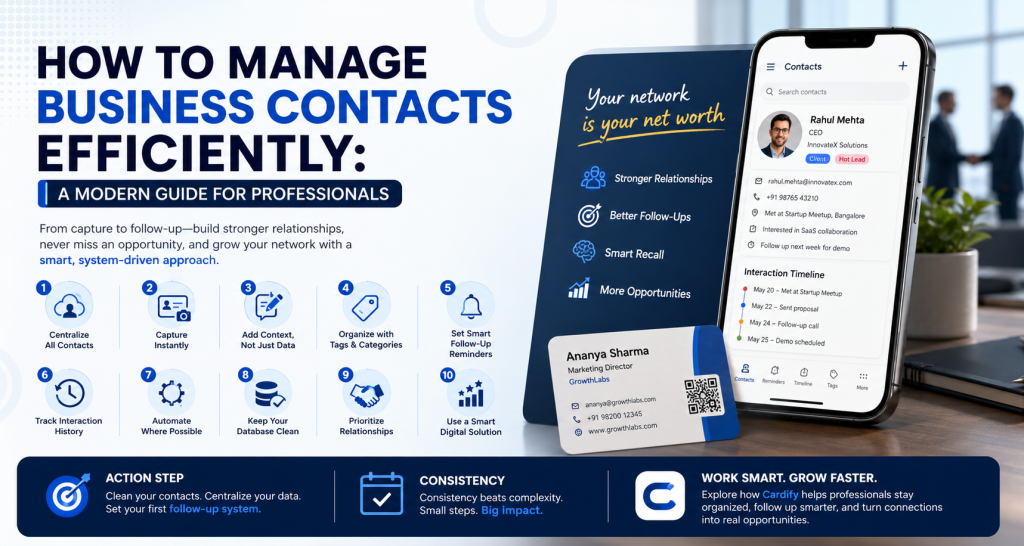
How to Manage Business Contacts Efficiently: A Modern Guide for Professionals
In today’s hyper-connected business environment, your network is one of your most valuable assets. But collecting contacts is easy—managing them effectively is where most professionals struggle. Missed follow-ups, lost business cards, and unorganized data can cost real opportunities.
This guide breaks down a practical, system-driven approach to managing business contacts efficiently, so you can turn every connection into a long-term opportunity.
Why Contact Management Matters More Than Ever
Every meeting, event, or introduction has potential value. However, without a structured system:
- Contacts get buried in spreadsheets or phones
- Follow-ups are delayed or forgotten
- Context behind conversations is lost
- Opportunities slip through unnoticed
Efficient contact management ensures:
- Stronger professional relationships
- Higher conversion from leads to clients
- Better recall and personalization
- Increased productivity
Step 1: Centralize All Your Contacts
The first rule: never scatter your data.
Many professionals store contacts across:
- Phone contacts
- Email inboxes
- WhatsApp chats
- Business cards
- Excel sheets
This fragmentation creates chaos.
Solution:
Use a single centralized system where every contact lives. This ensures:
- Easy access
- No duplication
- Consistent updates
Step 2: Capture Contacts Instantly
Speed matters. The longer you wait, the more details you forget.
Best Practices:
- Save contacts immediately after meeting
- Use digital tools instead of manual entry
- Scan or digitize business cards instantly
What to Capture:
- Name, company, designation
- Phone, email
- Context (where you met, what you discussed)
- Tags (e.g., client, investor, vendor)
Step 3: Add Context, Not Just Data
A contact without context is just a number.
If you meet 20 people at an event, how will you remember who matters?
Add Notes Like:
- “Met at startup meetup”
- “Interested in SaaS collaboration”
- “Follow-up next week for demo”
This transforms your contact list into a relationship intelligence system.
Step 4: Organize with Tags and Categories
Not all contacts are equal.
Segmenting your contacts allows you to:
- Prioritize high-value leads
- Send targeted communication
- Track relationship stages
Example Categories:
- Hot leads
- Clients
- Partners
- Investors
- Cold contacts
Tagging helps you filter and act faster.
Step 5: Set Smart Follow-Up Reminders
Most deals are lost due to poor follow-up—not lack of interest.
Common Mistake:
“I’ll remember to follow up later.”
You won’t.
System Approach:
- Set reminders immediately after saving contact
- Define follow-up frequency (1 day, 3 days, 1 week)
- Track interaction history
Consistency builds trust—and trust drives business.
Step 6: Track Interaction History
Professional relationships evolve over time.
Without tracking, you risk:
- Repeating conversations
- Forgetting commitments
- Losing credibility
Maintain a Timeline:
- Calls made
- Messages sent
- Meetings done
- Deals discussed
This helps you pick up conversations exactly where you left off.
Step 7: Automate Where Possible
Manual processes slow you down.
Automation can:
- Remind you to follow up
- Organize contacts automatically
- Sync data across devices
- Reduce human error
The goal is simple: less effort, more consistency.
Step 8: Keep Your Database Clean
An outdated contact list is as bad as no list.
Regular Maintenance:
- Remove duplicates
- Update outdated information
- Archive inactive contacts
A clean database improves efficiency and decision-making.
Step 9: Prioritize Relationships, Not Just Numbers
Having 5,000 contacts means nothing if you engage with none.
Focus on:
- Quality interactions
- Consistent communication
- Value-driven conversations
Your network should work for you—not overwhelm you.
Step 10: Use a Smart Digital Solution
Modern professionals need more than just a contact-saving app.
An ideal solution should offer:
- Centralized contact storage
- Instant capture and scanning
- Smart tagging and categorization
- Automated follow-up reminders
- Interaction tracking timeline
This is where platforms like Cardify come in—designed to help professionals not just store contacts, but convert connections into opportunities.
Final Thoughts
Efficient contact management is not about saving numbers—it’s about building relationships at scale.
If you implement even a few of these steps, you will:
- Never miss a follow-up
- Always remember context
- Strengthen your network
- Close more opportunities
Your network is your net worth—but only if you manage it right.
Action Step
Start today:
- Clean your existing contacts
- Centralize your data
- Set your first follow-up system
Consistency beats complexity.
Looking to upgrade your contact management system? Explore how Cardify helps professionals stay organized, follow up smarter, and grow their network effortlessly.